
Armádní dagger Mikov UTON 362-NG-4 /POLICE
Code: 362-NG-4/POLICERelated products


Product detailed description
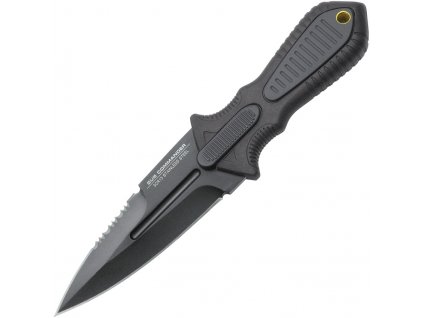
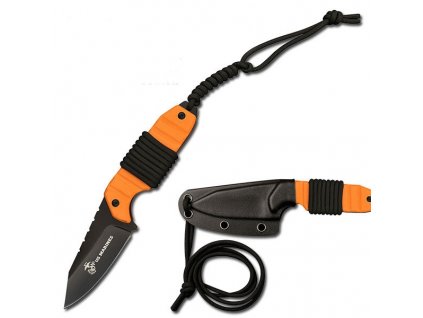
This is a variant of the UTON dagger popular with the Czech Police and municipal police forces.
It consists of the 362-NG dagger, the blade of which is made of high quality stainless steel type 420 with hardness 53-55 HRc, length 140 mm and has a wedge cut, on the face side is embossed with the number 0007. The longer blade is only available in UTON AZ. The handle of the dagger is made of hardened rubber, which prevents easy slipping due to its grip on the palm. It has a hole for attaching accessories (saw, file, spike) and a locking hole for paracord cord with a pin.
UTON 362-NG-4/POLICE comes with a 362-4 BLACK LEATHER sheath - black leather sheath with nickel-plated KIN DOT knobs and an accessory pocket, including a metal planchet to prevent the dagger from falling out.
The sheath is equipped with a saw, file and black paracord cord.
Total weight is 0,346 kg
UTON 362-NG-4/ARMY is one of the original products of Mikov s.r.o. Mikulášovice.
- blade material: stainless steel 420 - 52-55 HRc
- blade material: hardened rubber
- sheath: including leather sheath
- blade length (mm): 250
- blade length (mm): 140
- blade width (mm): 24
- blade thickness (mm): 3,7
Additional parameters
| Category: | Army fixed knives |
|---|---|
| Blade material: | stainless steel |
| Blade length: | 10 to 15 cm |
| Handle material: | rubber |





Be the first who will post an article to this item!

The tradition of knife-making associated with the Mikov brand has its roots in Mikulášovice in northern Bohemia, which was known as Nixdorf in the 18th century. It was here that a systematic approach to the production of knives and cutlery began to take shape, based on manual dexterity, local materials, and gradual technical improvement. The town's location in the very north of Bohemia contributed to strong links with German knife-making regions, from which technology, ideas, and business contacts flowed.
The region was long inhabited by itinerant knife makers who worked in small workshops and produced blades hardened in simple furnaces, often directly in their homes. Their skills caught the attention of merchant Ignaz Rösler, who managed to concentrate the scattered craft into the first organized factory production. This laid the foundation for industrial steel processing in the region, where emphasis was placed on repeatable quality, precise grinding, and functional blade shaping.
The originally relatively small operation grew rapidly thanks to high demand for cutlery and knives, which were renowned for their reliability and durability. The expansion of production led to the specialization of individual work steps, with separate departments for hardening, grinding, and assembly, which increased productivity and the technical level of the final products. The success of the first factory motivated other residents of the region to establish related workshops, grinding shops, and forging operations, transforming Mikulášovice into a continuous center of knife production.
Over time, a unique ecosystem of crafts emerged, where experience was passed down from generation to generation and the technical details of production were constantly refined. Typical Mikulášovice production was based on high-quality carbon steel, careful heat treatment, and an emphasis on ergonomics. It was this combination of tradition, technical discipline, and industrial thinking that led to the town being nicknamed the Czech Solingen. This legacy continues to shape the perception of the Mikov brand as a symbol of Czech knife-making, where historical experience blends with modern production and practical use.
| Manufacturing company : | Mikov s.r.o. |
|---|